Welcome to soft Haven

Going Deeper With Third Eye Energy
On intuition, perception, and the rooms where we hear ourselves think
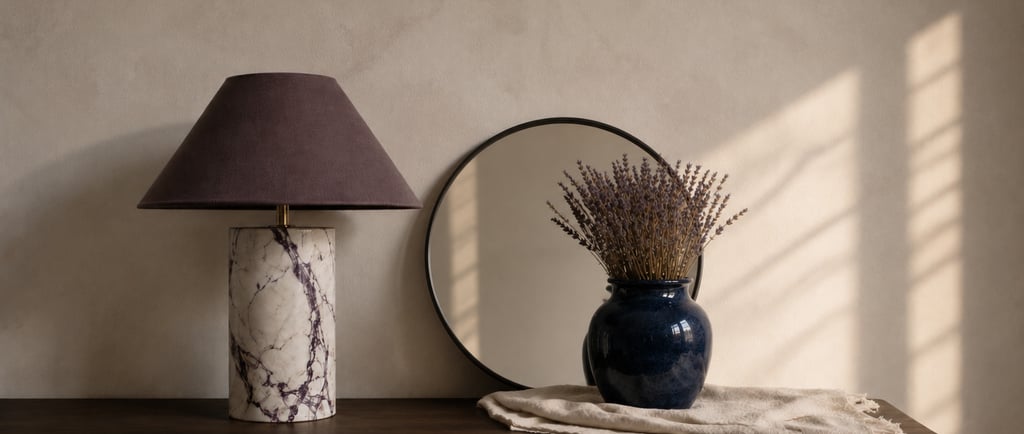
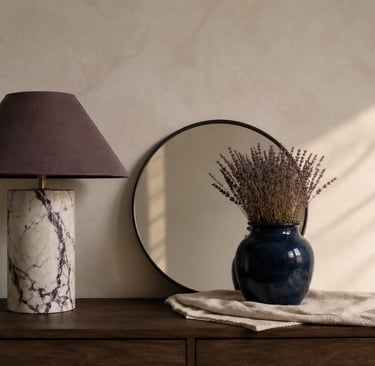
A feeling about a decision you can't quite explain. A sense about a person before they've said much. The flicker of recognition when you walk into a place and your body decides, without consulting you, whether you're staying.
Intuition.
A gut feeling, an instinct, a hunch. The names matter less than the experience- and most of us have spent our adult lives talking ourselves out of it.
Third Eye energy is the practice of trusting that signal again. The quiet voice underneath the louder ones, the one that's usually right and rarely loud. The part of you that already knows and is waiting for you to listen.
A room shaped by Third Eye energy doesn't try to entertain you. It tries to give you the quiet in which your own knowing becomes audible.
The feeling behind the room
A Third Eye room is somewhere your brain has space to be inward.
Low-stimulation environments shift the brain into what neuroscientists call the default mode network, the network that activates when you're not focused on the outside world. This is the state where insight surfaces: where the answer to a problem arrives in the shower, where you suddenly understand what was bothering you about a conversation, where the creative connection clicks. The default mode network is also where the brain consolidates memory, processes emotion, and integrates intuition.
A Third Eye room creates the conditions for this state by reducing the inputs the brain has to process. Dim light. Deep color. Quiet objects. The room invites the brain to stop outputting and start resolving.
If the room could speak, it wouldn't say "trust your intuition." It would say "the answer is already in here."
The materials that carry this energy
Third Eye energy lives in materials with depth, density, and quiet weight.
Deep navy velvet, the textile that absorbs light rather than reflects it. A navy velvet sofa, a navy accent chair, a navy lumbar pillow on a cream bed. Navy reads as the color of a sky between dusk and full night, late enough for stars, early enough for thinking. The room recedes into it.
Marble with veining and cast brass, stone that holds time inside it. A marble lamp base, a cast brass sculpture, a marble side table with violet veining. These materials don't decorate the room. They anchor it. The eye lands on them and stops moving.
Dried lavender, eucalyptus, and dark botanicals introduce the chakra's signature stillness. A small bundle of lavender on a console. A few eucalyptus stems in a deep vessel. Botanicals that aren't trying to bloom. The room is past blooming. It's thinking.
Linen and cotton in ivory, cream, and soft taupe carry the palette into the soft surfaces. A single cream lumbar pillow on a navy sofa. A folded throw. The light textiles in this room are doing contrast work — they're what keeps the navy from swallowing the room whole.
These are materials that hold. Nothing in a Third Eye room should be in a hurry.
The palette
Deep navy, gold leaf, marble white, eggplant, walnut.
An evening sunset that wants you to notice it, to be in awe of it, so it can whisper something to you.
Third Eye tones quiet you. The body reads a room in these colors as a place where it's safe to not have the answer yet.
Third Eye isn't about being dark. It's about being deep. A single navy wall does more work than four. One gold-flecked painting does more than three pieces of art. The room's power comes from the depth of one color, not the range of many.
The light
Light in a Third Eye room should feel low, late, and a little dim.
This is the only room in the series where the goal isn't more light. One lamp on, not two. Overhead off.
A Third Eye room should look like dusk even at three in the afternoon. Indirect. Quiet. Candlelit. Light pooling in one corner, not flooding the room.
A small ritual for this space
Try this once, in whichever room of your home holds the most Third Eye energy.
Turn the overhead off. Turn one lamp on.
Sit somewhere quiet and close your eyes for a moment longer than feels useful.
Then ask yourself one question: what do I already know?
Not what you're supposed to figure out. Not what you need more information about. The thing you already know and have been pretending not to.
You don't have to do anything with the answer. You just have to admit it's there.
If nothing surfaces today, that's also the practice. Come back tomorrow. Sit a minute longer. The answer isn't on a timeline.
That's the entire practice.
Not meditation. Not contemplation. Knowing.
Soft Haven
Contact
hello@softhavenliving.com
© 2026. All rights reserved.
This site contains affiliate links. I may earn a small commission at no extra cost to you.